
Dark Mode
How can you build a website structure that drives engagement and visibility? Learn the ins and outs with examples, key elements and best practices.


Published: June 26, 2026
Website Structure: Key Highlights
-
Your website is your best salesperson: Your site is what converts traffic into leads and sales. Structure is what makes that happen.
-
Know your customer: Every module, every page, every link should focus on what your customer wants when they arrive.
-
Less is more: If you have 12 links in your navigation, you’ve already lost the user. Give people what they need and cut everything that doesn’t belong.
91% of businesses say their website is their top marketing channel. Yet most invest more time debating color palettes than thinking about the architecture that determines whether it converts.
We sat down with Gariel Shaoolian, CEO of Digital Silk, to get his unfiltered take on how high-performing businesses should approach website structure, from the first page of a sitemap to the last internal link.
1. What Is Website Architecture & Why Is It Important?
91% of businesses agree that their website drives more revenue than any other channel.
As such, it’s not only the face of your company, but your most important marketing asset.
All your campaigns on Google, Meta or any other channel are supposed to bring in the traffic, but your site is what converts visitors into a lead or sale.
Website architecture is the structural blueprint that makes that possible. It defines how your pages are organized, how your content is labeled and how everything connects.
Below is a visual representation of what your site architecture could look like:
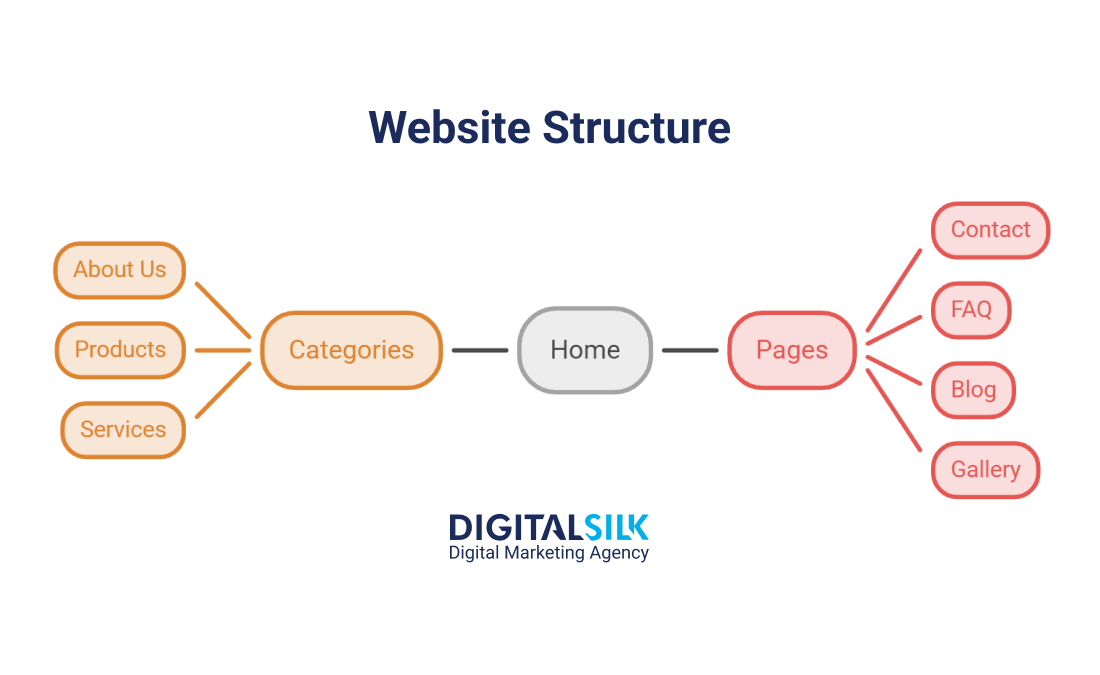
This is different from information architecture, which is the thinking behind how you organize your content or navigation, acting as just one piece of the whole.
2. How Do You Approach Planning A Website’s Structure?
The website architecture is defined by your layout, messaging, catalog and conversion funnel.
Think of it as the architecture of a store. When someone walks in, you want them to immediately know where to go, understand you offer and move naturally toward a purchase. Your website should do exactly the same thing.
The order in which you do things is also important. You build the sitemap first to establish your primary pages, then structure each page individually.
Start simple and add complexity later. Don’t try to launch with all the bells and whistles. Look at your core user journeys, get those right and build from there.
Need help planning your site structure?
3. How Does Site Structure Affect The UX, SEO & AI Search In Your Experience?
It affects all three and they’re more connected than most people think. For users, a good website structure means they can easily find what they need. They follow a logical path from broad to specific and that journey feels natural.
As the Nielsen Norman Group notes, unclear labeling and navigation are among the top reasons users abandon a site without converting.
When it comes to SEO, the structure determines how efficiently Googlebot can crawl and index your pages.
A logical hierarchy ensures that important pages are never more than a few clicks from the homepage, which means they accumulate more internal link equity and rank more easily.
Orphaned pages or those with no internal links are essentially invisible to Google regardless of how good their content is.
Per Google Search Central’s site structure documentation, a crawlable link structure is one of the most fundamental technical requirements for a site to perform in search.
While AI-powered search has seen a significant rise, the concern is often overstated. Yes, 77.9% of professionals worry about AI-generated answers reducing clicks to their sites.
But if you follow the best practices of giving people what they actually want, it doesn’t fundamentally change anything.
AI reads your website the same way a human reader does. Make sure your text is readable, not trapped in an image or a non-indexable format.
If you’re providing content that someone else has already published, there’s no value in that for Google or AI. Create unique content that’s true to your brand and your expertise.
What AI search has really done is punish generic content even faster. The bar for informative, valuable, original insights has never been higher.
4. What Are The Different Website Architecture Models?
There are four main website architecture models. The right one depends on your content volume, your users’ browsing behavior and your business goals.
| MODEL | HOW IT WORKS | BEST FOR | PROS | CONS |
| Hierarchical | Tree structure: home > categories > sub-pages | Most business and eCommerce sites | Intuitive, SEO-friendly, scalable | Can become too deep if not managed |
| Sequential | Linear path from page A to B to C | Onboarding flows, checkout, forms | Clear direction, high completion rates | Rigid; poor for exploratory browsing |
| Matrix | Users navigate via search or filters rather than a fixed path | Large databases, knowledge bases | Flexible, user-driven | Harder to crawl; requires good search |
| Database / Hub | Content is tagged and pulled dynamically into hubs | Blogs, news sites, product catalogs | Scales well; surfaces related content | Complex to plan and maintain |
Most businesses use a hierarchical model as the backbone, with matrix or database elements for content-heavy sections like a blog or resource library.
5. What Are Some Best Practices For Sitemap Design?
Your sitemap controls how search engines discover and prioritize your content. You could go in one of two ways:
- XML sitemaps are files you submit to Google Search Console that list every URL you want crawled and indexed. Keep it simple: only include canonical, indexable URLs. Remove redirected, noindexed or duplicate pages.
- HTML sitemaps are user-facing pages that list your site’s content in organized sections. They’re less critical for SEO than they once were, but they’re still useful for large sites where users want to browse the full content inventory.
Think about which pages go at the top level of your sitemap design, as opposed to those that become sub-pages. You can decide based on what your user wants to see, not what you think is most important from a business perspective. Those two things are often very different.
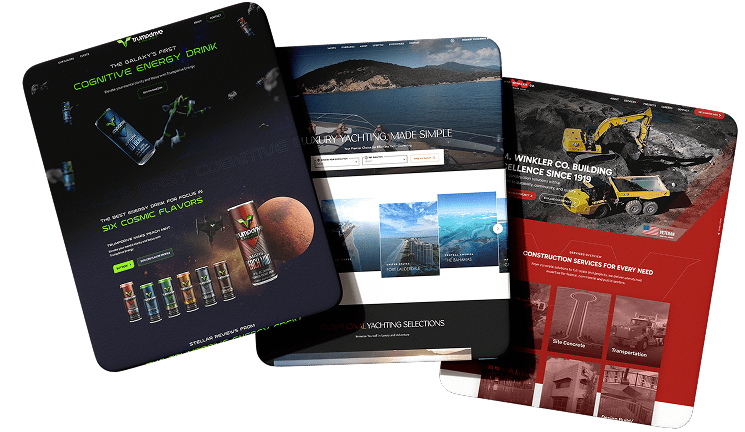
If you’re an eCommerce brand, users want product categories first. If you’re a service provider like Digital Silk, they want to see examples of your work and your services. They want to understand what you offer before they care about who you are.
Looking to optimize your sitemap?
6. What Is Your Philosophy On URL Structure & How Does It Connect To SEO Performance?
It has to make sense to the user first, so it can then make sense to Google. Don’t overthink it. Follow the logic of how visitors would explore your business and map your URLs to that.
Make sure that your URL structure mirrors your hierarchy directly. Here’s what that could look like in practice:
| Good URL | Bad URL |
| digitalsilk.com/web-design/ux-design | digitalsilk.com/page?id=4471 |
| store.com/furniture/sofas/leather | store.com/cat2/sub7/item |
| blog.com/seo/website-structure | blog.com/2019/04/12/post-title-here |
7. What Is The Process For Auditing & Restructuring An Existing Site?
The structural best practices don’t change whether you’re building new or restructuring. What changes is the data you have available.
Use the following steps to improve your information architecture and site structure:
- Crawl the site: Use a tool like Screaming Frog or Sitebulb to surface all URLs, their status codes, their depth and any orphaned pages.
- Cross-reference with Google Analytics: Export your traffic data and map it to the crawl output. Pages with zero sessions over the past 90 days that also have no strategic link equity value are candidates for consolidation or removal.
- Identify problem areas: Common issues include pages buried at click depth 4 or deeper, large clusters of thin or near-duplicate pages, navigation items pointing to low-traffic pages and orphaned landing pages from old campaigns.
- Prioritize fixes: Start with the changes that affect your most important pages: homepage, core service or product pages and high-traffic blog content.
- Redirect safely: When you remove or consolidate pages, always use 301 redirects to point the old URL to the most relevant surviving page. Never delete a page that has inbound links or organic traffic without redirecting it.
Want to audit your existing website structure?
8. What Are Common Mistakes Businesses Make With Their Website Architecture?
The mistakes are usually obvious once you know what to look for, such as:
- Deep nesting: Burying content four or five levels deep hurts both users and crawl efficiency. Search engines prioritize pages closer to the homepage in the link graph. If your most valuable content requires multiple clicks to reach, it will underperform regardless of its quality.
- Orphan pages: Pages that exist in the CMS but have no internal links pointing to them are effectively invisible. They won’t rank, they won’t convert and they dilute your overall site quality in Google’s eyes.
- Bloated navigation: A navigation bar with more than seven items is rarely justified. Less is more. Every additional link dilutes the attention and link equity passing to the items that matter most.
- Duplicate paths: Multiple URLs leading to the same content splits your ranking signals and creates canonicalization issues that are easy to avoid and costly to ignore.
- Weak mobile navigation: 51.04% of global traffic comes from mobile, yet most sites are designed and tested on a desktop. Collapsible and hamburger menus are the right approach, but if your most important links are buried three taps deep, you’ve lost the user. Keep your most critical pages within one tap and use expandable sections to manage content length.
Need help with mapping out your website?
9. If A Business Owner Took Away Just One Principle From This Conversation, What Would You Want It To Be?
Know your customer. Everything else flows from that. Who are they? What do they want when they arrive at your site? What question are they trying to answer, or what problem are they trying to solve?
The numbers back this up. 91% of users have encountered a digital experience issue in the past year. The most common result is lost sales, with 55% choosing not to complete a purchase. Get the structure wrong and you feel it in revenue.
Structure the entire site around that experience. If every decision you make (every module, every page, every link) is based on your customer, you’ll build something that performs.
Want to optimize your website’s structure?
Plan & Build Your Website With Digital Silk
Structure is what determines whether your site converts the traffic you’re paying to bring in.
Our team builds websites designed from the ground up to perform, combining UX research, conversion-focused architecture and proven SEO frameworks to drive measurable business results.
As a leading web design agency, our solutions include:
Contact our team, call us today at (800) 206-9413 or fill in the Request a Quote form below to schedule a consultation.
Request A Quote For Your Website Project
Tell us about your website goals and let our experts give you a custom proposal
"*" indicates required fields


